
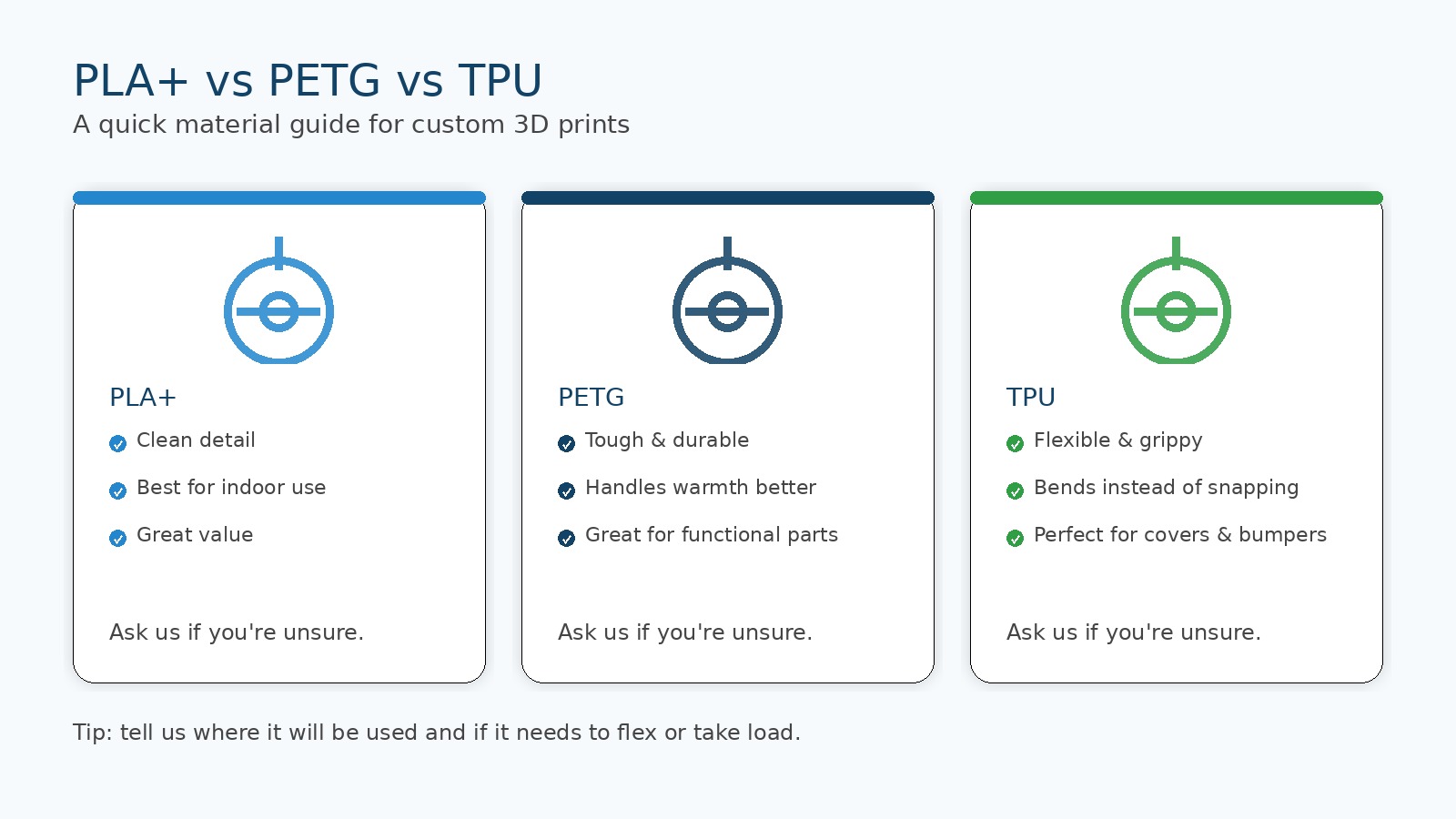
One of the most common questions we get is: “Which material should I print this in?” If you’re choosing between PLA, PETG, and TPU, you’re already in a great place — these three cover most everyday custom 3D printing needs.
This quick guide keeps it simple (no jargon, no fluff). If you’re still unsure after reading, send us what you’re making and how it will be used — we’ll recommend the best option for your print.
Quick pick (60 seconds)
- PLA — best for clean detail, organisers, display pieces, and most indoor parts.
- PETG — best for tougher functional parts that might get knocked, handled, or used more heavily.
- TPU — best when you need flexibility (grips, bumpers, covers, soft-feel parts).
PLA vs PETG vs TPU (simple comparison)
| Material | What it’s like | Typical uses |
|---|---|---|
| PLA | Clean detail, solid feel, great for most everyday indoor prints | Decor, desk organisers, prototypes (fit/shape), light-use parts |
| PETG | Tougher and more durable for functional use | Brackets, mounts, protective parts, working pieces that get handled |
| TPU | Flexible, grippy, bends instead of snapping | Phone grips, covers, bumpers, flexible clips, soft-touch parts |
PLA (the clean, everyday choice)
PLA is the go-to for sharp detail and great surface finish. It’s perfect for most indoor items and anything where you want it to look tidy straight off the printer.
- Best for: organisers, display models, prototypes (fit/shape), decorative prints.
- Why it’s loved: prints cleanly and captures detail really well.
- Worth noting: if your part will live in a very warm spot or take repeated heavy knocks, tell us — we may suggest PETG instead.
PETG (tougher for functional parts)
PETG is a great choice when you want a part that feels more durable for regular use. If it’s going to be handled often, tightened, clipped, or used as a working piece, PETG is usually the safer bet.
- Best for: brackets, mounts, replacement parts, protective pieces.
- Why it’s chosen: tougher feel and better suited to day-to-day functional use.
TPU (flexible and grippy)
TPU is the one you pick when you need flex. It’s ideal for parts that should bend, absorb impact, or feel softer in-hand.
- Best for: covers, bumpers, grips, flexible clips, anti-slip parts.
- Why it’s useful: it bends and recovers instead of snapping.
What to tell us so we can recommend the right material
If you message us with these details, we can usually recommend a material quickly (and quote accurately too):
- Where it will be used: indoor/outdoor, warm areas, damp areas, etc.
- What it needs to do: hold weight, clip on/off, flex, resist knocks.
- Fit requirements: does it need to be a snug fit (and what does it fit onto)?
- Finish expectations: “display tidy” vs “purely functional”.
- Quantity + colour preference: one-off, small batch, or more.
Ready to print?
Send your STL (or describe what you need) and we’ll recommend the best material, confirm pricing, and share lead time.
Get a quote Ask a questionRelated links
- Portfolio — examples of recent prints
- FAQ — common questions about printing, files and lead times
- Back to Blog