Most people who've never commissioned a custom 3D print assume one of two things: either it's going to cost a fortune, or it's going to be as quick as ordering a print off a shelf. Neither is quite right.
Custom 3D printing sits somewhere in the middle — more involved than picking something off a marketplace, far cheaper than injection moulding or CNC machining. The trick is knowing what you're getting into before you send the enquiry.
This post walks through how the process actually works when you commission a print from us. No jargon, no upsell — just what happens from first email to delivered part.
When a Custom Print Makes Sense
Not every job needs a bespoke print. Before you enquire, it's worth asking whether one of these fits your situation:
- You can't find what you need off the shelf. Replacement parts for discontinued products, one-off brackets, custom-sized organisers — this is the sweet spot for custom work.
- You have a design but no printer. Plenty of makers buy STLs or design their own files but don't own a printer, or don't want to commit to a long print on their own machine.
- You need a small batch, not a mass run. Anything from 1 to a few hundred units is fair game. Past that, injection moulding or vacuum forming usually makes more sense.
- You want a prototype before committing to production. 3D printing is ideal for testing fit, form, and function before you spend serious money on tooling.
If your project fits one of those, a commission is worth the enquiry. If you're trying to mass-produce 5,000 identical widgets as cheaply as possible, 3D printing isn't the right tool and we'll tell you so.
What We Need From You
The more information you send in the first enquiry, the faster and more accurate the quote comes back. Here's what helps:
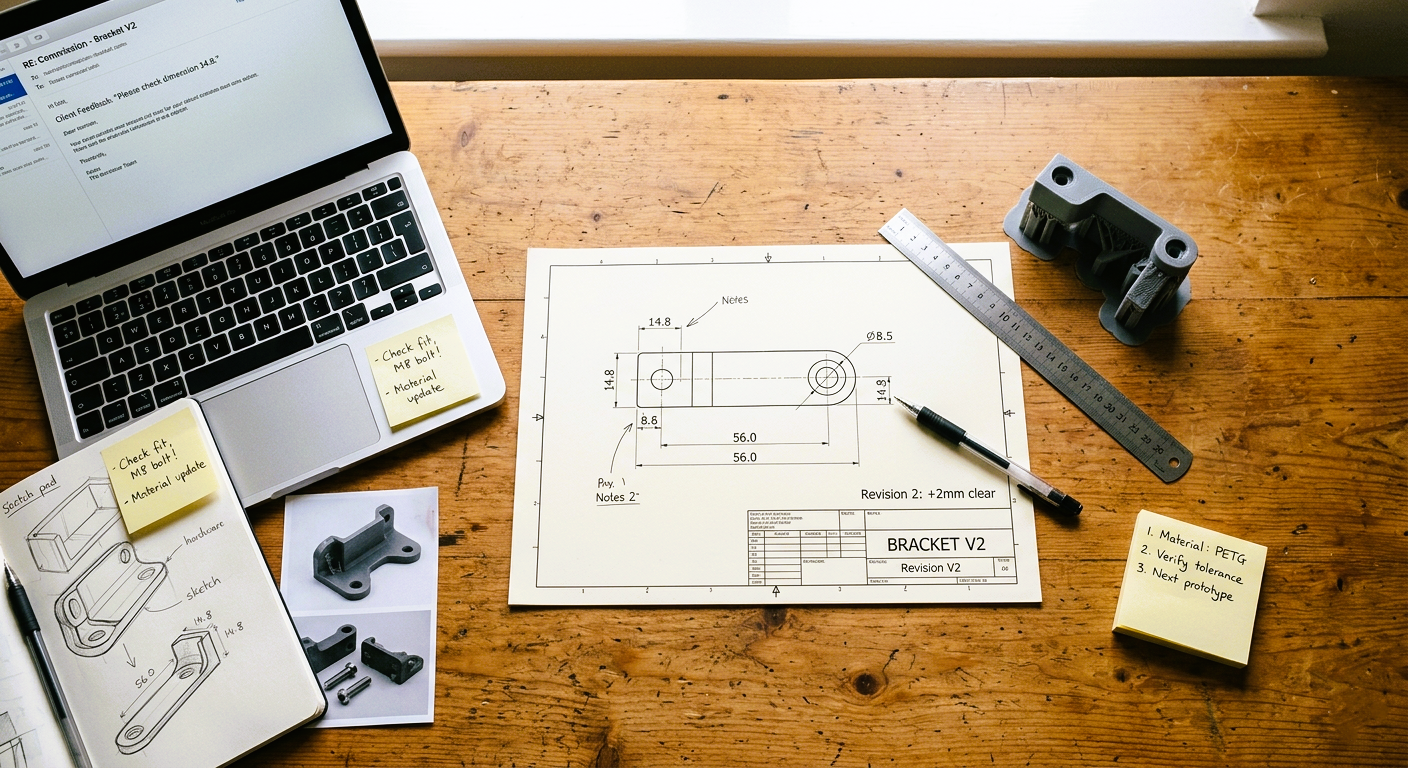
- A 3D file if you have one. STL, 3MF, STEP, or OBJ all work. If you only have a 2D drawing, a sketch, or reference photos, that's fine too — we'll flag whether it needs design work first.
- Rough dimensions. Even a "roughly 100mm tall, fist-sized" is useful if you don't have exact measurements.
- What it's for. A decorative piece, a functional bracket, a part that needs to bear weight, something that lives outdoors — the use case changes the material and the print settings.
- Quantity. One-off, ten, fifty? Pricing and lead time both scale with quantity.
- Any colour or finish preferences. We'll suggest options if you're not sure.
- Your deadline. If you need it for a specific date, say so upfront. Rush jobs are sometimes possible but cost more.
If any of those are unclear, just send what you have. Most commissions start with a vague brief and get refined over a couple of messages.
The Process, Step by Step
Here's what happens once you've sent the enquiry:
1. We reply with questions or a quote. If the brief is clear, you'll get a quote within a working day or two. If it's not, we'll come back with the questions we need answered. No quote goes out until we know we can deliver what you're asking for.
2. Design work (if needed). If you don't have a file, we'll either quote for the design work separately or fold it into the total. You'll see a preview render before we print anything. You get a set number of revisions built into the quote — we'll tell you upfront how many.
3. Sign-off. Once you approve the design, the quote, and the timeline, we invoice for the job. Payment is usually upfront for small jobs, 50% deposit for larger ones.
4. Printing. This is where the lead time sits. A small decorative piece might print in a few hours. A large functional part can take 20+ hours. Multiply that by quantity and you get why lead times vary. We'll give you a realistic despatch date — not a best-case one.
5. Finishing. Depending on the brief, parts might need sanding, painting, assembly, or post-processing. We'll agree this at the quote stage so there are no surprises.
6. Despatch. Parts go out via tracked courier from our Wednesfield workshop. You get a tracking number and usually delivery the next working day within the UK.
Lead Times
Typical lead times, assuming no design work needed:
- Small simple parts (1–5 units): 3–5 working days
- Medium jobs (10–30 units or longer prints): 1–2 weeks
- Larger or complex jobs: 2–4 weeks, sometimes longer
- Jobs requiring custom design: Add 3–7 days for design and revisions
These are guidelines, not guarantees — actual lead times vary depending on what's already on the printers, material availability, and the complexity of the job. We'll always give you a realistic timeline before you commit, and flag early if anything changes once the job is underway.
If you have a hard deadline, tell us early. We can sometimes prioritise a job for a small rush fee, but not always — depends on what else is in the queue.
What to Expect From the Finished Part
Honesty upfront, because this saves everyone time later:
- FDM prints have visible layer lines. Close up, you'll see horizontal bands. This is normal for this method. If you need a glass-smooth finish, resin printing or post-processing (sanding, priming, painting) is the answer — we'll recommend the right approach at the quote stage.
- Colour matches are approximate. Filament colours vary slightly between batches and don't always match exactly to RAL or Pantone codes. If exact colour matching matters, we'll discuss options.
- Functional parts have limits. 3D printed parts are strong, but they're not injection-moulded nylon. If a part needs to take serious load or heat, we'll advise on material choice or flag where 3D printing isn't the right fit.
If any of this changes your mind about the project, better to know now than after you've paid.
Get in Touch
If you've got a project in mind — even a vague one — send us an enquiry through the custom quote page. Include whatever information you have and we'll come back with questions or a quote.
No obligation, no sales pressure. Worst case, we tell you 3D printing isn't the right fit for what you need and point you towards a better option.